Bhimrao Ramji Ambedkar
भीमराव रामजी आंबेडकर |
|---|
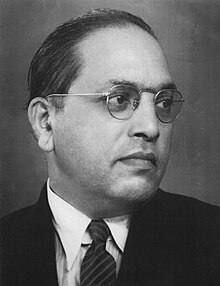 Babasaheb Ambedkar |
| Born | April 14, 1891
|
|---|
| Died | December 6, 1956 (aged 65)
|
|---|
| Nationality | Indian |
|---|
| Spouse(s) | Ramabai Ambedkar
Savita Ambedkar |
|---|
|
 |
Bhimrao Ramji Ambedkar (14 April 1891 – 6 December 1956), popularly known as Dr. Babasaheb Ambedkar was an Indian jurist, economist, politician and social reformer. He inspired the Dalit Buddhist Movement and campaigned against social discrimination against Untouchables (Dalits), and also supported the rights of women and labour. He was independent India's first law minister, the principal architect of the Constitution of India and a founding father of the Republic of India.[1][2][3][4][5][6][7][8]
In 1956, in Deekshabhoomi, he initiated a mass conversion of Dalits, converting to Buddhism with 600,000 supporters. He revived Buddhism in India. Ambedkar is regarded as a bodhisattva, and the Maitreya, among the Navayana Buddhists.[9][10][11][12]
In 1990, the Bharat Ratna, India's highest civilian award, was posthumously conferred upon Ambedkar. Ambedkar's legacy includes numerous memorials and depictions in popular culture. Ambedkar's legacy as a socio-political reformer had a deep effect on modern India.[13][14]
Ambedkar was voted "the Greatest Indian" in 2012 by a poll organised by History TV18 and CNN IBN, ahead of Vallabhbhai Patel and Jawaharlal Nehru.[15]
Ambedkar Jayanti (Ambedkar's birthday) is an annual festival celebrated on 14 April, which is celebrated not only in India but all over the world. Ambedkar Jayanti is celebrated as an official public holiday throughout India.[16][17][18] The United Nations celebrated Ambedkar Jayanti in 2016, 2017 and 2018.[19][20][21] He is also known as No. 1 Scholar in the world by Columbia University.
Ambedkarite model of agriculture
1. Agriculture shall be state industry.
2. The State shall acquire the substing rights in such industries, insurance and agricultural land held by private individuals, whether as owners, tenants or morgagers and pay them compensation in the form of debentures equal to the value of his/ her right in the land.
3 Agriculture industry will be organised on the following basis
(a ) The State shall devide the land acquired into farms of standard size and let out the farms for cultivation to residents of village as tenants ( made up of group families) to cultivate on the following conditions:
a,)The farm shall be cultivated as a collective farm;
b) The farm shall be cultivated in accordance rules and directions issued by Government.
c) The tenants shall share among themselves in the manner prescribed the produce of farm left after the payment of charges properly leviable on the form.
2. The land shall be let out to villagers without distinction of caste or creed and in such manner that there will be no landlord , no tenant and no landless labourer
3.It shall be the obligation of the State to finance the cultivation of the collective farms by the supply of water , draftanimals, implements, manure, seeds etc.
4. The State shall be entitled to--
a) levy the followin charges on the produce of the farm:
1. a portion for land revenue;
2. a portion to pay for the use of capital goods supplied; and
b) to prescribe penalties against tenants who break the conditions of tenancy or wilfully neglect to make the best use of the means of cultivation offered by the state or otherwise act prejudicially to the scheme of collective farming.
The model requires the State to play principle role in this and asks to punish the rule breakers. Agriculture is recognised as indusry owned by state and individual will not have right over the land and he will be paid price of the land by way of debentures. The State will supply inputs and the cultivators will be free to share among themselves the produce according to the prescribed rules. Hence this obviates farmers' suicides and save them from price fluctuatios and market whim.
B.A.(Bombay University)
MA.(Columbia university)
M.Sc.( London School ofEconomics)
Ph.D. (Columbia University)
D.Sc.( London School of Economics)
L.L.D.(Columbia University)
D.Litt.( Osmania University)
Barrister-at-La w (Gray's Inn,
London) law qualification for a lawyer in
Royal Court of England.
/////////////


അഭിപ്രായങ്ങളൊന്നുമില്ല:
ഒരു അഭിപ്രായം പോസ്റ്റ് ചെയ്യൂ